Rav Eliyohu Chaim Carlebach zt"l
הרב אליהו חיים קרליבך זצ"ל
Adar 26 , 5749
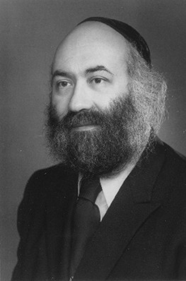
Rav Eliyohu Chaim Carlebach zt"l
A Tribute To My First Rov
Many people know of Rav Elya’s famous twin brother, Rav Shlomo Carlebach. In fact, I also found Rav Elya through Rav Shlomo’s reputation, but it is Rav Elya whom I will always consider my first Rav.
Rav Elya and Rav Shlomo were born in Vienna in the late 1920s to a prominent and wealthy Rabbinic family. Their father, Rav Naftoli Carlebach, moved the family to Germany for the sake of his sons’ education, but by the 1930s, they had immigrated to America, early enough to have escaped the war. Rav Naftoli Carlebach established a shul on West 79th Street in Manhattan, which is now run by his great-grandson, Rav Elya’s grandson, Rav Naftoli Citron.
Rav Naftoli Carlebach was not Chassidish, but when his sons grew older, they became close to the Lubavitcher Rebbe. Rav Elya married the Lubavitcher Rebbe’s first cousin, Hadassa, may Hashem bless her with a long and healthy life. They had children and he established his own shul in Staten Island. He became an expert on all types of Chassidus and published an encyclopedia of Chassidus, respected in many different kehillos. I like to think that his tefillos helped bring me to my current point in life, a Chassidista of the Stoliner Rebbe.
Rav Shlomo, who was the elder twin, succeeded his father as Rav of the 79th Street shul, but at some point, the brothers began to run it jointly. They used to alternate Shabbosos; one Shabbos would be led by Rav Shlomo, the next by Rav Elya, and when Rav Shlomo was touring, Rav Elya led for many weeks in a row. Therefore, when I went to the shul looking for Rav Shlomo, I met Rav Elya “by accident”.
I had first heard of Rav Shlomo Carlebach in the East Village, of all places. Skipping over the details, I was a cosmically confused teenager, dabbling in leftist politics and astrology. I went to the shul at 79th Street, and had a memorable experience, but nothing that immediately changed my life. It wasn’t until I’d spent a few years in college getting even more cosmically confused that I finally decided to go check out the Carlebach shul again.
I was surprised that Rav Shlomo wasn’t there, but in many ways Rav Elya was even more welcoming. He heartily invited me to the seuda, and after it, the Rebbetzin told me I could stay upstairs and read for the afternoon. Unfortunately, I took the subway home that afternoon, but I liked the experience enough that I went back for another Shabbos shortly thereafter. Rav Elya welcomed me again, saying he was very happy to see me. So I kept going back, and as I got to know him better, I began to espouse some of the views I’d picked up in college and in political meetings. And the fact that I could do so is the greatest tribute to Rav Elya. No matter how far I had strayed, no matter what outrageous view came out of my mouth, Rav Elya Chaim always made me feel welcome and loved.
Rav Eliyohu Chaim Carlebach, may the memory of this Tzaddik be a blessing, left this world right before Shabbos, in March 1990. The congregation was gathered for Shabbos, waiting to see him, when they told us. That Shabbos, we sang his favorite songs, told over his teachings, and shared memories. It was a hard, but healing Shabbos. People broke down in tears at different times. I remember watching my own teardrops fall on the tablecloth while some stranger looked at me sympathetically. I must have been crying harder than I realized.
One phrase people attributed to Rav Elya in their stories was, “Just be normal.” He had never actually said that phrase to me, but it succinctly summed up the message he had been conveying to me throughout the entire year of our acquaintance. Normalcy was a good value for me to strive for. It certainly wasn’t a value in hippiedom or leftism, and after years of identification with both those worldviews, I certainly was not my normal self.
After the loss of a dear authority figure, it is very common that the young and bereft resolve to follow the path of the deceased more devotedly. How else can they connect with the niftar, the person who left this world? The person is gone in body, so the connection must be on a purely spiritual plane. I’ve been told that the Tanya says that a Tzaddik accomplishes more in this world when he leaves it because then he is not encumbered by physicality. I don’t claim to understand how that works, but I think that the effect on the bereft that I described must be part of it. As Rav Shlomo used to say, “What do I know?”
May Rav Elya be a meilitz yosher for Klal Yisrael. Oh, how I miss him!
My father was a strong believer in everyone being master of himself. With Hashem guiding us, we have no excuse for stupidity or even depression. He believed that we can all reach the top. He often told us, “Just be smart.” And, if anyone ever dared to hurt my feelings, he would say to me, “You let that cockroach crawling on the floor have control over you?”
He was a magnificent father and a terrific grandfather, too. Fortunately, he lived to see ten of the many grandchildren born. The stories are being relayed to the great grandchildren as well.
(Sheina Carlebach Berkowitz)